 PawCompass 毛孩有方
The Long Journey Home: A Pet's Route from China to Australia
Last updated: 2026-08-11
On this page
- Can pets fly directly from Beijing to Australia?
- What is the documented Beijing–South Korea–Melbourne route?
- What is the practical sequence for the Korea route?
- Can Hong Kong be an alternative route to Australia?
- What documents and health preparation do cats and dogs need?
- How long should you plan for pet relocation from China to Australia?
- How much does the Australian government-side process cost?
- How can you verify an agent and its success stories?
- How should you make the final relocation decision?
- FAQ
The short answer is: a cat or dog cannot be imported directly from Beijing or elsewhere in mainland China into Australia. The practical route is to move the pet to an Australian-approved country or territory, complete rabies vaccination, an RNATT blood test and at least 180 days of continuous residence there, then fly as manifested cargo directly to Melbourne. Owners seeking to reduce Australian quarantine from the usual 30-day minimum to the 10-day minimum should also arrange competent-authority identity verification before the RNATT.
The independently documented China-origin success story in this guide used China → South Korea → Melbourne. Hong Kong is a legally available alternative and its Australia-bound export process is well established, but we did not find an independently reported end-to-end Mainland-to-Australia case completed under Hong Kong's post-June 2025 Mainland import regime.
| Route | Existing evidence and conditions |
|---|---|
| China → South Korea → Melbourne | An independently documented China-origin success story; the pet completes Australian preparation in South Korea before Melbourne quarantine |
| China → Hong Kong → Melbourne | A legally available route with an established Australia-bound export process; this guide did not find an independently reported end-to-end case under Hong Kong's post-June 2025 Mainland import regime |
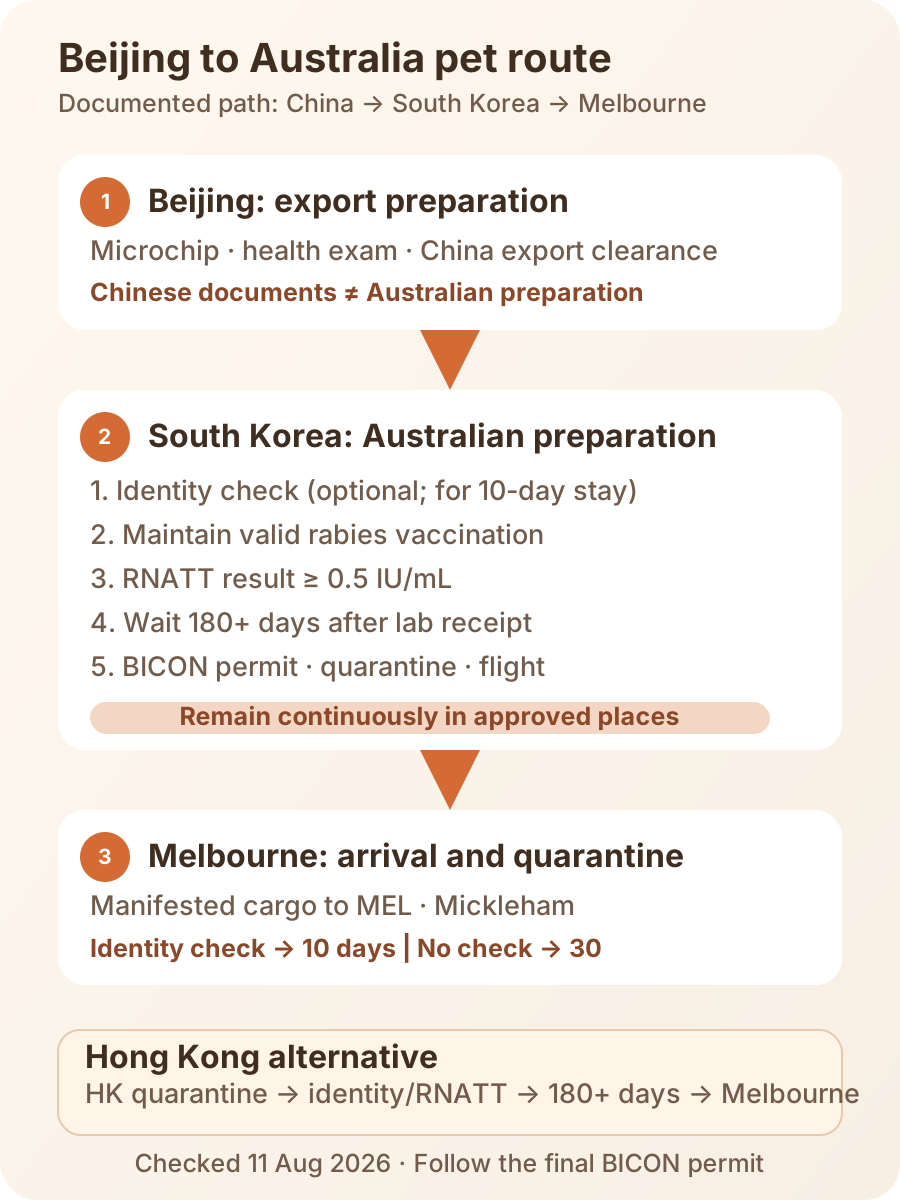
Can pets fly directly from Beijing to Australia?
Pets cannot fly directly from Beijing to Australia because Australia only accepts direct cat and dog imports from approved Group 1, 2 or 3 countries and territories. Mainland China is not on that list. A pet originating in a non-approved country may become eligible only after living continuously in an approved place for at least 180 days and meeting every condition attached to the final country of export.
The 180 days is a residence period, not necessarily confinement in a quarantine kennel. The pet may live with its owner or in compliant boarding, but it cannot return to mainland China. For a Group 3 export, the countdown begins when the qualifying RNATT sample reaches the laboratory.
Check the Australian Department of Agriculture FAQ, country groups and RNATT guidance.
What is the documented Beijing–South Korea–Melbourne route?
The Beijing–South Korea–Melbourne route in this guide is documented by a 2023 ABC interview with Vicky Liu, who moved from China to South Korea with her husband and two Pomeranians, Princess and Boombah. They lived in South Korea for six months, repeated the Australian veterinary preparation there and later reunited after the dogs completed quarantine in Melbourne. It was one of the first publicly reported cases under Australia's stricter March 2023 rules.
The reported economic impact exceeded AUD 50,000, but that figure included six months of Airbnb accommodation and lost income for two adults. It is not a pet-freight quote. Read the ABC case.
What is the practical sequence for the Korea route?
- Check eligibility first. Confirm breed, age, health, microchip and fitness to fly. Brachycephalic, elderly or chronically ill pets need an individual welfare assessment.
- Meet Chinese export and Korean entry rules. A Chinese health certificate supports departure and Korean entry; it does not replace Australian certification.
- Decide whether to arrange Australian identity verification. This is optional but recommended. To seek the 10-day Australian quarantine minimum, it must be performed through the Korean competent-authority process before the RNATT blood draw and not at the same appointment. Skipping it does not make the pet ineligible, but normally results in a 30-day minimum stay.
- Maintain valid rabies vaccination and complete the RNATT. The result must be at least 0.5 IU/mL.
- Wait at least 180 days. The period starts when the qualifying sample reaches the laboratory, while the pet remains continuously resident in approved places.
- Apply for the Australian import permit. A Group 3 application normally includes the RNATT report and the competent-authority-endorsed RNATT declaration.
- Book Mickleham quarantine and transport. The pet must travel as manifested cargo and arrive directly at Melbourne International Airport.
- Complete final testing, parasite treatment and official certification. Dogs exported from South Korea must also meet permit-specific canine influenza requirements.
- Complete Australian quarantine. A compliant pre-RNATT identity check generally enables a minimum 10-day stay; otherwise the minimum is normally 30 days. Non-compliance can extend it.
Before paying, obtain written confirmation from Korea's Animal and Plant Quarantine Agency or the authority responsible for export certification that it will perform Australia's identity check and later certify continuous residence and the Australian-format health certificate for the individual pet.
Can Hong Kong be an alternative route to Australia?
Hong Kong can be an alternative route because, since June 2025, it has classified Mainland cats and dogs under Group IIIA. When every condition is met, the minimum Hong Kong quarantine is generally 30 days. After that, Hong Kong's AFCD can handle Australian identity verification and export certification.
Treat it as two separate processes:
Beijing → meet Hong Kong import rules → minimum 30-day Hong Kong quarantine
        → Australian identity check → rabies/RNATT → at least 180 days
        → direct Hong Kong–Melbourne cargo flight → Australian quarantine
Do not follow historical guides that send a pet to Hong Kong for a vet visit and then return it to Beijing during the waiting period. Returning to mainland China breaks the required continuous approved-country residence.
See the official Hong Kong requirements for pets from Mainland China and AFCD process for export to Australia.
What documents and health preparation do cats and dogs need?
The core file usually includes a compliant ISO microchip, valid rabies vaccination, RNATT records, an Australian BICON import permit, Mickleham booking, official health records and an IATA-compliant crate:
- a readable, compliant ISO microchip with an identical number on every document;
- if seeking the 10-day Australian quarantine minimum, competent-authority identity verification in the approved exporting country;
- continuously valid rabies vaccination;
- a passing RNATT report and official RNATT declaration;
- an Australian BICON import permit;
- a Mickleham quarantine reservation;
- the official export health certificate, tests and parasite records;
- an IATA-compliant crate and manifested-cargo booking.
Dogs may need leptospirosis and Brucella canis measures, and dogs exported from South Korea have permit-specific canine influenza vaccination requirements. Cats have tightly timed internal and external parasite treatments. Always follow the issued permit rather than copying another pet's schedule.
Use the current Group 3 dog guide or Group 3 cat guide.
How long should you plan for pet relocation from China to Australia?
Allow roughly 8 to 12 months for the Korea route:
- First 1–2 months: confirm eligibility, health and microchip, then complete Korean entry preparation.
- About one month after arrival: if seeking 10-day quarantine, arrange the identity check first, then vaccination and RNATT, subject to competent-authority appointments.
- At least the next 180 days: complete the mandatory period measured from the qualifying sample's arrival at the laboratory.
- During the wait: arrange the Australian permit, quarantine booking, flight and final paperwork, with contingency time.
- After Australian arrival: complete a minimum 10- or 30-day stay at Mickleham.
Hong Kong also requires its own pre-entry RNATT timing, quarantine reservation and minimum 30-day quarantine. A failed titre, vaccination lapse, microchip error or lack of flight and quarantine availability can reset or extend the schedule.
How much does the Australian government-side process cost?
For the first pet, the DAFF FAQ currently estimates the Australian government-side total at AUD 3,114 for a minimum 10-day quarantine and AUD 4,234 for a minimum 30-day quarantine; these totals include the permit, quarantine and associated services.
| Australian quarantine minimum | DAFF FAQ government-side estimate | DAFF fee-table minimum line items |
|---|---|---|
| 10 days | AUD 3,114 | AUD 2,938 |
| 30 days | AUD 4,234 | AUD 4,058 |
Adding only the minimum line items on DAFF's fee table produces the lower figures of AUD 2,938 and AUD 4,058. The AUD 176 difference matches the current weekday out-of-hours collection fee. Because the FAQ provides the more conservative official total, this guide uses AUD 3,114 and AUD 4,234 as the planning baseline. These estimates still exclude China export work, Korean or Hong Kong import, six months of residence or boarding, veterinary work, air freight, crate, agents and emergency care. Total expenditure can reach tens of thousands of Australian dollars. Recheck the official fee FAQ, current permit fees and quarantine charges before paying.
How can you verify an agent and its success stories?
Ask for redacted documents from a recent case on the same route instead of relying on airport videos, social posts or “we have done Australia before”:
- the first page of the Australian Import Permit;
- the competent-authority identity verification;
- RNATT report and RNATT Declaration;
- a sample official export health certificate;
- Mickleham booking or release record;
- a client reference you can contact independently;
- a contract covering boarding location, daily welfare, medical authority, cancelled flights and responsibility for document errors.
Stop and verify directly with the Australian department if an agent proposes returning the pet to China during the 180 days, entering through Sydney or Brisbane, carrying the pet in the cabin, or guaranteeing completion in under six months.
How should you make the final relocation decision?
South Korea has publicly documented evidence for a China-origin relocation under the stricter Australian rules. Hong Kong is a regulatory alternative but adds its own entry quarantine and may take longer overall. Compare animal welfare, owner access and document authority—not just price.
Before committing, prepare a one-page profile with species, breed, date of birth, weight, microchip, vaccination history, desexing status and target arrival date. Send the same profile to the intermediate country's competent authority, Australian BICON and each shortlisted agent. Start irreversible payments only when the three answers align in writing.
Information checked 11 August 2026. Rules, fees, flights and quarantine availability change. This guide supports planning and does not replace the issued BICON permit, the exporting competent authority or individual veterinary advice.
FAQ
Can a pet fly directly from Beijing to Sydney or Melbourne?›
No. Mainland China is not an approved place of export for Australian cat and dog imports. The pet must first live continuously in an approved country or territory for at least 180 days, complete that exporting country's Australian preparation and then arrive directly in Melbourne.
Can a rabies vaccination and RNATT completed in China be used for Australia?›
They do not replace the Australian process. Australia's required vaccination, testing and official certification must be completed in an approved exporting country. Chinese documents are mainly used to leave China and enter the intermediate country.
Is South Korea or Hong Kong better documented?›
South Korea has a complete post-2023 case independently reported by the ABC. Hong Kong has a clear regulatory pathway and many Hong Kong-to-Australia cases, but we did not find an independently documented end-to-end case under the Mainland import regime introduced in 2025.
How long should the move take?›
Allow roughly 8 to 12 months for the Korea route. The mandatory 180 days starts after the qualifying RNATT sample reaches the laboratory. Hong Kong also has its own entry preparation and minimum quarantine, so it may take longer.