 PawCompass 毛孩有方
Puppy Socialisation in Australia: Critical Period, Vaccines and Safe Exposure
Last updated: 2026-08-14
On this page
- What socialisation actually means
- Why the sensitive period matters
- Starting safely before full vaccination
- Six groups of useful positive experiences
- How to run one safe session
- A traffic-light rule for continuing or stopping
- Case study: how Kikopup reduces difficulty
- Case study: the Seeing Eye Dogs system
- Common mistakes
- When to seek professional help
- A final note: skills that support socialisation
- FAQ
Puppy socialisation is not a race to tick off the largest number of people, dogs and places. Its purpose is to help a puppy feel safe in everyday life, recover from small surprises and trust that moving closer or moving away are both available choices. Success does not mean loving everyone; it means being able to observe, explore and reconnect with a caregiver without distress escalating.
What socialisation actually means
Four related ideas are often blurred together:
- Socialisation introduces a developing puppy to people, animals and the social world through positive experiences.
- Habituation is learning that a harmless sound, object or situation does not require a strong response.
- Training teaches specific skills such as responding to a name, recall, loose-lead walking and settling on a mat.
- Management uses gates, leads, distance and routines to prevent danger and stop unwanted behaviour being rehearsed.
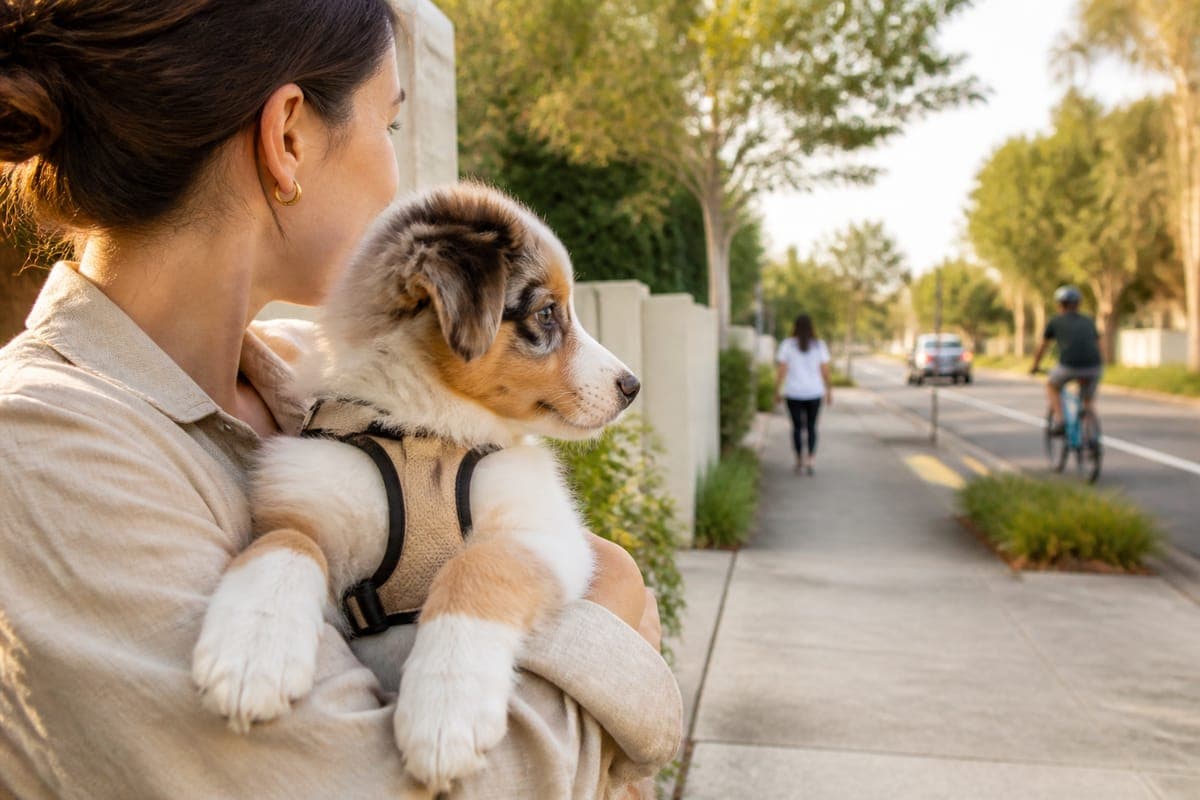
A puppy does not need to interact with every stranger or dog. Watching a bicycle from a comfortable distance and returning to sniffing may be more useful than a forced close greeting.
Why the sensitive period matters
The Australian Veterinary Association's December 2024 policy describes the sensitive socialisation period as beginning at about 3 weeks and waning at around 14 weeks. RSPCA Australia, AVSAB and the Pet Professional Guild Australia use slightly different boundaries, producing a practical range of about 3–14/16 weeks.
The variation reflects different definitions, evidence summaries and communication choices—not a brain that stops learning on a set birthday. Genetics, the breeding environment, maternal health, early care, physical health and individual temperament all affect pace. Treat this as an especially important and often efficient learning window, never as a deadline for flooding a puppy with novelty. Dogs can keep learning later, but may need smaller, more carefully planned steps.
Starting safely before full vaccination
Disease exposure and missed early learning are both genuine risks. The answer is neither total isolation nor unrestricted access. Ask the vet caring for your puppy about local parvovirus risk, health and the individual vaccination schedule.
Within that advice, lower-risk options can include:
- household sounds, umbrellas, hats, appliances, safe surfaces and everyday objects;
- observing pedestrians, bicycles and traffic while being carried or in an easily cleaned secure pram;
- short car trips with observation from inside the vehicle;
- controlled contact with familiar dogs of known health, suitable temperament and appropriate vaccination status;
- a clean, well-managed reward-based puppy class with health and vaccination requirements;
- avoiding dog parks, common toileting areas, dogs of unknown health and any public ground your vet identifies as high risk.
RSPCA Australia's vaccination guidance gives a general recommendation to wait at least 14 days after the final routine puppy vaccination before ordinary on-ground walks. That is not remote clearance for every puppy or postcode; your own vet should make the individual exposure decision.
Six groups of useful positive experiences
Use categories to notice gaps, not to create a quota:
- People of varied ages, appearances, clothing and movement, including hats, umbrellas, wheelchairs or prams—without requiring touch.
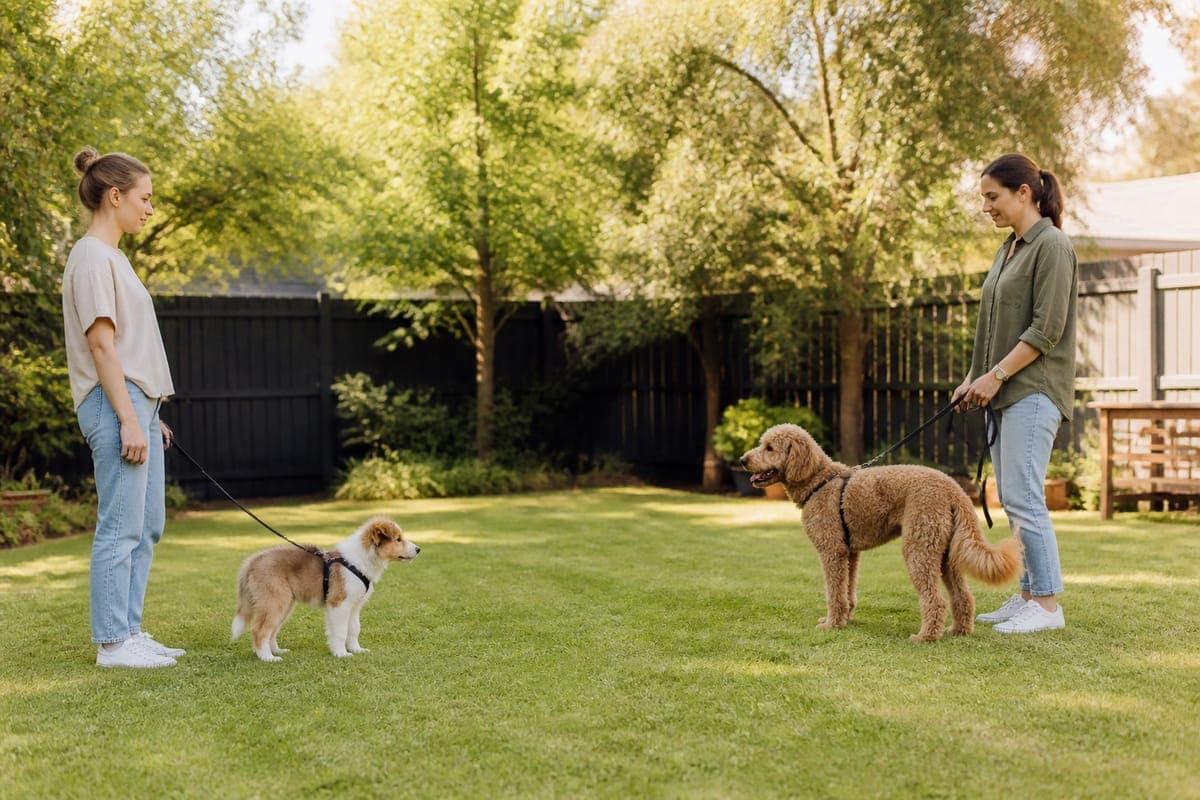
- Healthy, steady dogs selected for compatibility and space, rather than random dog-park encounters.
- Sounds such as appliances, doorbells, traffic, children and low-volume storm recordings.
- Surfaces and objects including grass, tiles, timber, safe mildly moving surfaces, boxes and carriers.
- Transport and places such as the car, outside a vet clinic, the edge of a quiet café or different rooms.
- Cooperative care involving ears, paws, mouth, tail, grooming and harnesses, using brief touch, reward and freedom to move away.
How to run one safe session
Begin far enough away for the puppy to remain comfortable. Pair the appearance of the new stimulus with food, play or gentle interaction the puppy enjoys. Keep the exposure brief and finish while participation is still voluntary. Next time, change only one variable: distance, volume, duration or movement.
Read clusters of behaviour: loose or stiff movement, sniffing and exploration, voluntary check-ins, ability to retreat and recovery after a mild startle. Taking food is one useful clue, not proof that the puppy feels safe. Likewise, a single yawn or lip lick cannot diagnose stress on its own; context, duration and the rest of the body matter.
A traffic-light rule for continuing or stopping
The AVA uses a traffic-light analogy to keep learning below the fear threshold:
- Green: the puppy is relatively relaxed, can explore, respond or rest, has choices and recovers from small surprises. Continue briefly.
- Amber: arousal or tension keeps rising, movement becomes stiff, avoidance repeats or re-engagement is difficult. Reduce intensity, add distance or take a break.
- Red: obvious fear, freezing, sustained escape attempts, tucked posture, fight-or-flight behaviour, prolonged barking or lunging, or poor recovery after leaving. Stop and move away.
Never require the puppy to complete one more repetition before leaving an amber or red situation. An exit is a safety strategy, not a reward for fear.
Case study: how Kikopup reduces difficulty
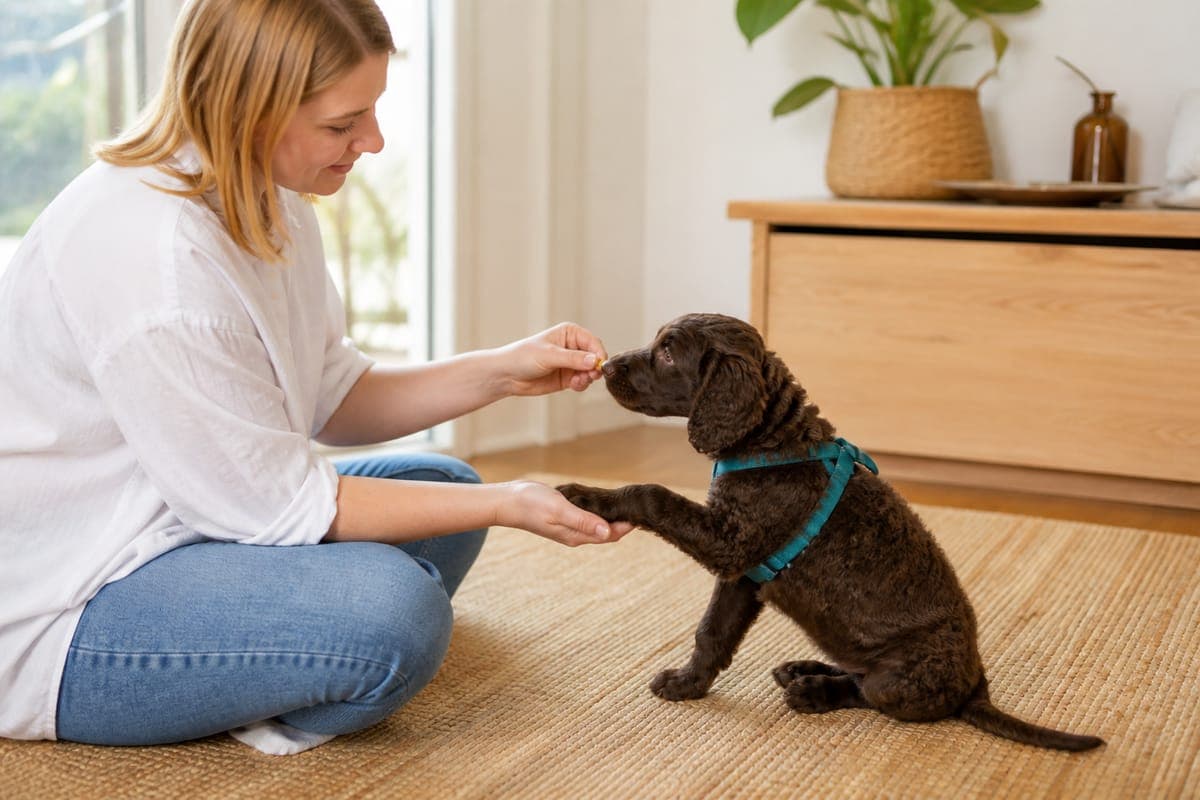
Emily Larlham's detailed Kikopup video, Avoid errors socializing your puppy, centres on distance, emotional state and choice rather than a checklist. Her complete session with a nine-week-old puppy and calm behaviour in new places show an easy attention or mat behaviour being established before the setting and distractions gradually change.
The transferable lesson is to teach the game in a simple environment, then generalise it. Leaving after one good, short exposure is preferable to staying until a puppy unravels. These are professional demonstrations, not randomised research or a complete before-and-after experiment for one puppy, so they cannot promise the same speed for every dog.
Case study: the Seeing Eye Dogs system
Vision Australia's The Seeing Eye Dogs journey: From puppy to partner shows a long system: puppy carers provide everyday experiences and foundations, formal training follows, and the dog's attributes are considered during matching. Socialisation is supported by rest, health, consistent home routines, generalisation and professional oversight—not delivered as a single event.
Working-dog programs have selective breeding, volunteer networks, professional teams and task-specific standards. Their timetable is not a benchmark for a pet puppy. Families can borrow the staged, supported structure without assuming identical outcomes.
Common mistakes
- Waiting for the vaccination course to finish before offering any new sight or sound.
- Forcing touch from strangers or nose-to-nose dog greetings.
- Treating a crowded dog park as remedial socialisation.
- Stacking car travel, crowds, dogs and handling into one exhausting day.
- Ignoring sleep and mistaking overtired behaviour for a need for more exercise.
- Calling a puppy disobedient when they stop eating instead of first reducing difficulty.
When to seek professional help
Contact a registered veterinarian when fear persists or worsens, aggression, resource guarding, separation panic or bite risk appears, recovery remains poor, or behaviour changes suddenly. The vet can assess pain and health before referring as needed to a qualified reward-based trainer or veterinary behaviour professional. Do not punish warning signals such as growling; suppressing a signal does not resolve the emotion beneath it.
A final note: skills that support socialisation
Name response, recall, loose-lead walking, mat settling, swapping objects and gradual alone time make socialisation safer and easier to exit. Continue with Puppy Training Schedule: A Week-by-Week Plan from 8 to 24 Weeks to fit those skills into daily life without turning every day into a test.
This guide is general education and cannot replace advice from a vet or qualified professional who knows your puppy's health, vaccination and behavioural history.
FAQ
When does the puppy socialisation period end?›
The AVA describes a sensitive period beginning at about 3 weeks and waning at around 14 weeks; other organisations commonly extend the range to about 16 weeks. It does not shut on one exact day. Safe, positive early experiences matter, and learning continues afterwards.
Can I socialise my puppy before all vaccinations are complete?›
Risk-managed socialisation can begin, but that is not the same as letting a puppy roam on high-risk public ground. Ask your own vet about local disease risk and the puppy's vaccination plan, then use options such as home experiences, carried observation, short car trips, known healthy dogs or a well-managed puppy class.
Can an incompletely vaccinated puppy attend puppy class?›
The AVA supports early socialisation with appropriate precautions. A clean, controlled class with health and vaccination requirements and reward-based teaching may be suitable. Show the class arrangements and your puppy's vaccination record to your vet before enrolling.
What should I do if my puppy is frightened of people or dogs?›
Do not force a greeting. Add distance and allow the puppy to observe or move away. End the session if they keep freezing, escaping, barking or lunging, or cannot recover afterwards, and seek help from a vet or a qualified reward-based behaviour professional.
Is it too late if my puppy missed early socialisation?›
No. Learning continues after the sensitive period, although progress may need to be slower and more structured. Do not compensate with intense exposure. Rule out health issues and begin at a distance and intensity where the puppy can remain comfortable.